Ishbel Angus
Lives and Works in London
B. 2000
-
-
MA in Painting – Royal College of Art, London (2024–2025)
First Class BA (Hons) in Painting and Printmaking – Glasgow School of Art (2020–2024)
International Exchange – Massachusetts College of Art and Design, Boston, US (2022)
Major Awards & Career Markers
RSA New Contemporary 2025 – Selected by the Royal Scottish Academy.
Sir William Bequest Award – Awarded by the Royal Scottish Academy.
High-Profile Press & Publications
Frieze Magazine (2024): Collaborative work 'Radio International' with Turner Prize-winner Susan Philipsz featured in the leading international contemporary art magazine.
Exhibition Catalogues: Featured in the RSA New Contemporaries 2025 publication and London Art Collective's ArtEvol 2025 catalogue.
Key Gallery & Institutional Exhibitions
(Filtered for high-profile gallery spaces, major cities, and international residencies)
London & UK Galleries
Saatchi Gallery, London – ArtEvol2025 with London Art Collective (September 2025).
The Royal Scottish Academy, Edinburgh – RSA New Contemporaries Group Show (2025).
Mall Galleries Consultancy, London – Mall Galleries x The Scalpel (The Chaucer Project) (August 2025 – August 2026).
Indra Gallery, London – BabyDoll Group Exhibition (June 2025).
Glasgow International Festival – Radio International collaboration with Susan Philipsz (June 2024).
International Exhibitions & Residencies
PADA Studios, Barreiro, Portugal – PADA 54 Residency Exhibition (November 2025).
NauArt, Barcelona, Spain – Collaborative painting exhibition (2023).
Massachusetts College of Art and Design, Boston, US – Away Show (2022).
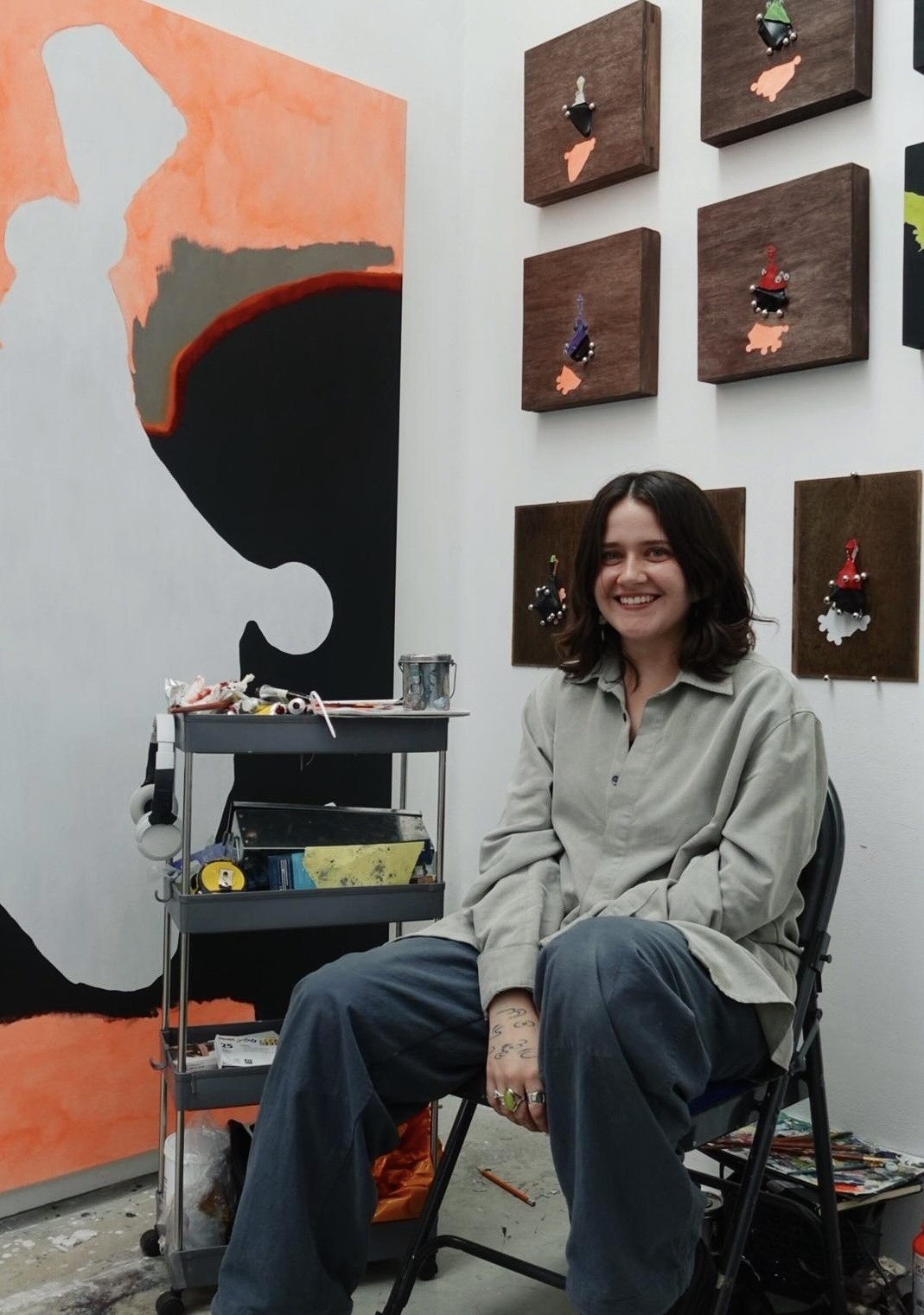
Ishbel Angus (b. 2000) is an emerging artist who has rapidly established a prestigious institutional presence across the UK. Holding a First Class BA from Glasgow School of Art and an MA from the Royal College of Art, their work has already been recognised by the Royal Scottish Academy and exhibited at the Saatchi Gallery.
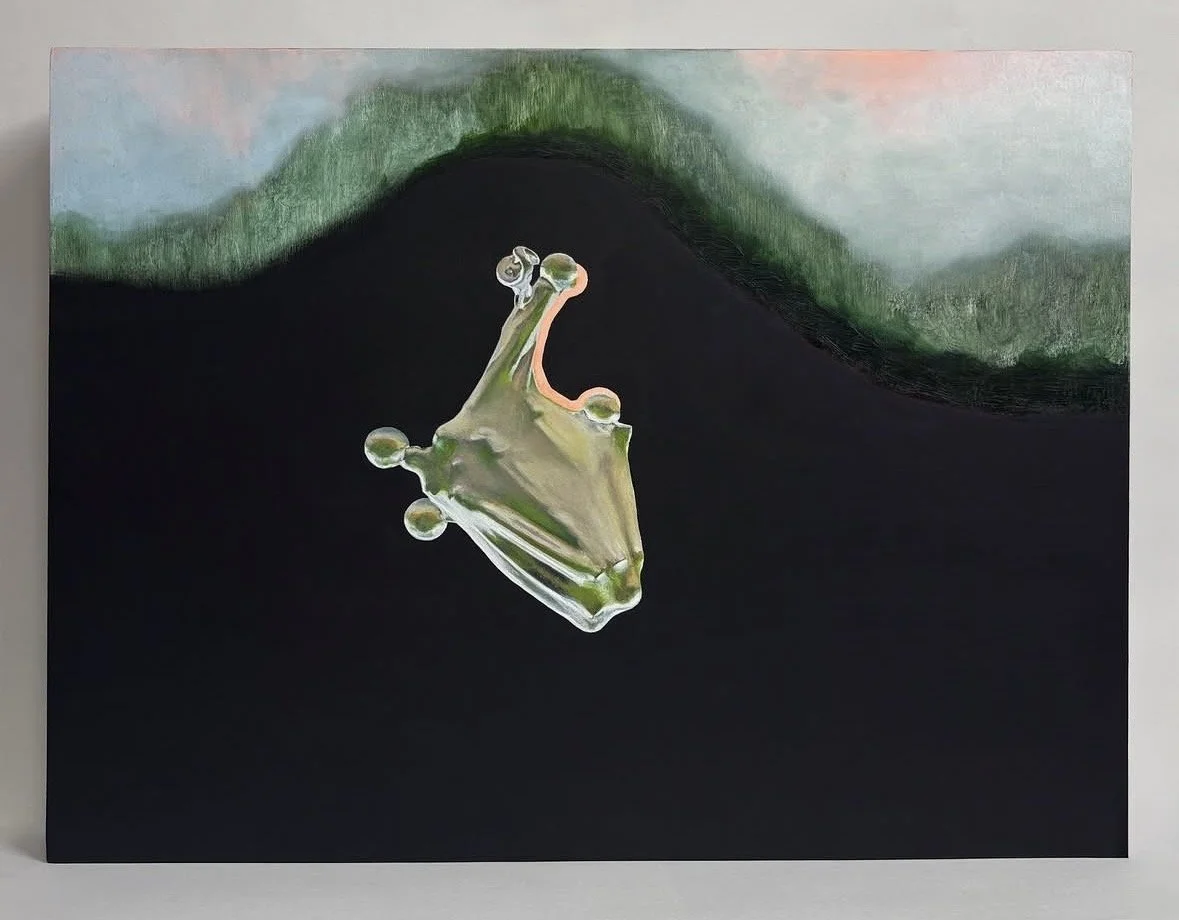
From Uhtceare series to Witch in a Bottle series , Angus's evolution as a painter is not simply a transition from colour to materiality : it is a shift in the direction of power. In Uhtceare, ordinary objects function as surrogates for a wounded self, absorbing what cannot yet be faced, offering the distance of the thing when the body proves too close. In Witch in a Bottle, the object is no longer a sanctury but a source: a container for power, curiosity, and reclaimed agency. Transference remains at the heart of her practice, but its direction has reversed. Where once the self offloaded into the object, now the object emanates outward.
Throughout, she has treated objects as sites of transference: vessels that hold what exceeds the body's capacity to contain , and ask the question what remains when the self fragments.
An Interview with Ishbel Angus
Ripple Verse Gallery (RVG): The series title Witch in a bottle sounds intriguing, what is the story behind it?
Ishbel Angus (IA): My most recent series Witch in a bottle is directly inspired by an amazing artefact found around 1912 in Sussex, England that’s currently held in the Pitt Rivers Museum, Oxford. I have been so deeply interested in this object since I first saw it as a child.
The mystery surrounding it is so alluring and almost seductive - did the witch get trapped? How do we even know that there actually is a witch inside there until we open the bottle? But if we open the bottle, there is a warning attached to the bottle saying that if the witch is unleashed then there will be a ‘peck o’ trouble’. I think it is also a bit like Schrodinger's Cat. How do we even know there’s anything inside without opening it? But do we risk opening it to find out? Do we free the witch?!
I think about Mark Fisher’s book ‘The Weird and The Eerie’. Like Fisher’s definition of eerie, the‘witch’ also actually retains power through partial concealment. Once the bottle is opened, the eerie or the ‘witch’ risks losing potential. So how can I utilise this knowledge in the work I am making? The paintings privilege speculation and potential over resolution, keeping the object both open and closed, real and illusory.
This was also what I was interested in when making the Uhtceare series, where these inflatable objects contained emotions and feelings.
RVG: You mean the lilo? it is quite a prominent object in that series, why lilo?
IA: In my previous series of work with the inflatable lilo’s, I used them as vessels for projecting dissociation, trauma and the lingering effects of gendered and sexual violence on the body.
These works became a kind of therapeutic transference, reclaiming the objecthood I felt in myself from passive commodification into active expression. I was reading Jane Bennett’s Vibrant Matter; A Political Ecology of Things’ at the time, and there was a specific bit where Bennett argues with Capitalist materialism, suggesting that “the sheer volume of commodities, and the hyperconsumptive necessity of junking them to make room for new ones, conceals the vitality of matter”. The sheer quantity of materials translates into immaterialism - or no sense of materialism. Bennett offers ‘vital materiality’. With this in mind, the plastic lilos, often used and abandoned for instance on holiday, become charged with presence while mirroring a disposability. Painting them in oil, a medium historically linked to flesh, further complicates this
object-body relationship. I realised that I was in a way painting flesh when painting the lilos and so I used this material dissonance. But I ultimately felt that these works were too representational and were therefore limited by their very own conception. A strange paradox formed where they were both critiquing and reinforcing a commodification of the queer and female body. I might go back to this idea as I feel I still haven't really decided what I think about it.
RVG: The ball bearings keep appearing, they’re industrial, precise, cold. What do they do to the softness of the fabric around them?
IA: The ball bearings are a site of tension and force, as well as a quite direct relation to the witch in a bottle artefact. They are magnets, holding together and connecting other magnets and materials.
In the paintings they hold a mini self-portrait, which you can only really see when you get up close. So in a way they hold the viewer, or the viewer's attention. I hope the inclusion of the self-portraits allow a portal for people looking at these works, as maybe they can imagine themselves being held in that space too. I think their industrial, cold feeling in contradiction with the stretchy, fluid latex creates more tension.
When I first started to think about the witch in a bottle artefact, I created a sort of logic for myself whereby the magnets are bones and tendons (the witch) and the balloon is flesh (the bottle) containing it.
I want the balloons and magnets in my work to function as bodily surrogates. They carry traces of gesture and body memory without explicit representation. I think a lot about concealing versus revealing in my work and exploring that by thinking about the witch inside the reflective metal bottle has been really fun.
The instability and mutability of balloons and magnets are central to my work, both materially and conceptually. These objects are both shaped by ‘unseen’ forces. Balloons rely on surrounding atmospheres and can also float. Their latex skins are malleable yet durable.
Magnets exert invisible forces of attraction and reflect and absorb their surroundings. These materials seem to blur science and mysticism and are quite enigmatic and cryptic even though quite recognisable.
RVG: The black ground appears in both, it's not empty, it feels active, almost atmospheric. What does the darkness mean to you?
IA: I chose that black paint very specifically as it’s super matte and feels almost absorbing. I like the activation it brings to the other materiality in the painting as it offers a contrast to the neon elements and saturated colours. I also really love the chiaroscuro technique used in a lot of Baroque and Renaissance paintings, especially in Caravaggio’s work, for example his painting ‘Narcissus’ as it’s very dramatic and contrasts the light and reflections and I wanted to reference that in a contemporary painting context.
RVG: Do you feel more powerful in Witch in a bottle than the Uhtceare, or more exposed?
IA: I definitely feel more powerful in the Witch in a bottle series as I felt that the Uhtceare series was a first attempt at painting about something very real and very painful, even though I had employed the lilo’s (the objects) as a form of transference and a way to remove the self.
It’s interesting though because I don't think I necessarily agree that removal of self is powerful. I'd like to become a bit more relaxed with the way I paint again. But at the moment, the logic and almost detached nature of the ‘Witch in a bottle’ series is something I have been really enjoying. Sometimes I find it's easy to get a bit lost in your own thoughts when you are making art and what helps me is to create almost a set of rules or limitations, for instance my reduced use of specific materials - balloons and magnets as inspiration. I found that this ended up helping with the huge question of: what next? I go back to a phrase a lot in my work which is what does freedom in restriction look like? And I have applied this very question to the way I make work at
the moment. I think there’s power in the way I am now constructing these objects myself.
RVG: Playfulness keeps appearing in how you talk about your practice , but these paintings feel serious, even solemn. Where does the play live in this work?
IA: I think what I mean by playfulness is keeping an open mind and keeping curiosity alive. Maybe playfulness is also something that allows you to be able to confront deeper, more serious things in life. So maybe playfulness and seriousness are quite connected.
RVG: If someone who knew nothing about your life stood in front of these paintings, what would you want them to feel before they read a single word about them?
IA: I don't have a set way of how I want my paintings to be perceived, so I will say intrigue or maybe just the willingness to look a bit closer at my work. Get absorbed into it!
Uhtceare and Witch in a Bottle
-
![Pepper Ghost]()
Pepper Ghost
-
![Float or Flight]()
Float or Flight
-
![Witch in a bottle]()
Witch in a bottle
-
![They Hover]()
They Hover
-
![Body]()
Body